
Digital signage in Malaysia has entered a decisive growth phase, with the Asia Pacific region projected to lead global market expansion at more than 8.81% CAGR through 2030.
For business owners and marketing managers evaluating digital signage solutions in Malaysia in 2026, this guide delivers the essential framework for making informed investment decisions across hardware, software, and implementation strategies.
This content covers display technology selection, content management system evaluation, accurate cost budgeting for the Malaysian market, and ROI calculation methodologies specific to local business conditions. We’ll take a close look at commercial digital signage applications while excluding consumer-grade displays and broadcast signage systems.
By the end of this guide, you will gain:
- Hardware selection criteria tailored to Malaysia’s tropical climate and import considerations
- A software comparison framework covering cloud-based and on-premise content management platforms
- Accurate cost budgeting templates for 2026
- ROI calculation methods validated by local case studies
- Vendor evaluation processes
Table of Contents
Understanding Digital Signage Fundamentals in Malaysia
Digital signage refers to dynamic visual communication systems that display content through digital screens, replacing traditional static signage with programmable, updateable messaging.
In Malaysia’s business landscape, the application of digital signage extends across retail, F&B, transportation hubs, and corporate environments, where it serves to captivate audiences, share real-time information, and enhance customer engagement in ways static displays cannot achieve.
The relevance to Malaysia’s market conditions is substantial. With urbanisation accelerating in major regions and the government’s Digital Economy Blueprint driving smart city initiatives, businesses across various industries recognise digital signage as infrastructure rather than luxury.
Malaysian consumer behaviour increasingly expects interactive content and real-time content updates. For example, digital menu boards in kopitiam chains and wayfinding digital kiosks in mega malls have become the norm.
Core Components of Digital Signage
Hardware
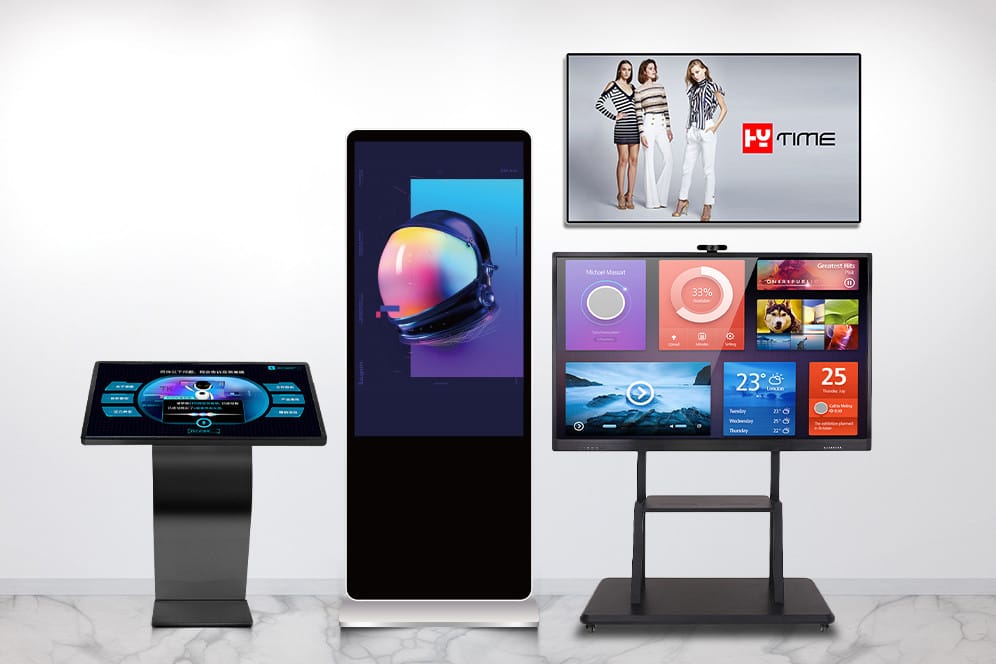
A complete digital signage system comprises four essential hardware elements:
- Displays (LED screens, LCD panels, or video wall configurations)
- Media players that process and deliver content
- Mounting systems suited to indoor or outdoor installatio
- Network connectivity enabling content management and monitoring
For Malaysian buyers, import considerations significantly impact hardware decisions. Displays from manufacturers like Samsung, LG, and Sharp NEC carry 5-10% import duties, while local distribution partnerships with proven expertise can reduce lead times and ensure technical support availability.
The tropical climate demands specific attention. Outdoor digital signage screens require IP65 ratings and brightness levels of 2,500-10,000 nits to combat direct sunlight, while indoor units benefit from anti-glare coatings to manage humidity-related condensation.
Software
The software component of digital signage solutions centres on the content management system (CMS), which handles content scheduling, remote display management, and analytics. Malaysian businesses face a fundamental choice between cloud-based platforms offering scalability for multi-location networks and on-premise solutions providing data sovereignty and reduced internet dependency.
Cloud-based digital signage software platforms deliver user-friendly software accessible from anywhere, critical for businesses with locations across Peninsular and East Malaysia. However, the relationship between hardware capabilities and software requirements needs careful matching. For instance, a basic media player cannot support 4K video wall solutions, while overpowered hardware wastes budget on simple digital display applications.
Understanding these foundational elements prepares buyers for the specific selection criteria that determine long-term success and cost effectiveness.
Hardware and Software Selection Criteria for Digital Signage in Malaysia
Building on these fundamentals, the selection process requires systematic evaluation against how businesses in Malaysia realistically operate. The display technology, processing hardware, and software platform must function as an integrated end solution tailored to your specific needs.
Display Technology Options
LCD, LED, and OLED technologies each serve distinct applications, with Malaysian climate considerations heavily influencing the optimal choice.
Display Technology | Best Use Cases | Key Strengths | Limitations | Typical Lifespan | Cost Consideration |
LCD | Indoor corporate spaces, retail stores, hospitality environments with controlled lighting | Cost-effective, reliable image quality, widely available sizes and formats | Limited brightness, less suitable for direct sunlight | Around 60,000 hours | Lowest upfront cost |
LED | Outdoor signage, large-format video walls, high-visibility public spaces | Very high brightness, scalable to large sizes, durable and weather-resistant | Higher upfront investment, requires professional calibration | 80,000 to 100,000 hours | 1.5–2x the cost of LCD |
OLED | Premium retail, showrooms, galleries, executive interiors | Exceptional contrast, true blacks, ultra-slim design, high visual impact | Lower brightness, higher risk of image retention, not suitable for outdoor use | 30,000 to 50,000 hours | Highest upfront cost |
Each display technology serves a different purpose, and there is no one-size-fits-all option. In Malaysia, LCD remains the practical choice for most indoor applications where lighting is controlled and budgets matter. LED is better suited for outdoor environments and high-impact installations that demand visibility and durability. OLED works best in premium indoor spaces where visual quality is the priority and content can be carefully managed.
Size and resolution recommendations:
- Retail window displays benefit from 55-65 inch high-brightness panels
- Quick-service restaurant with digital menu board applications require 43-55 inch displays at eye level
- Corporate lobbies make maximum impact with video wall configurations of 4-9 panels
- Transportation hubs require outdoor-rated LED walls visible from 20+ metres
Media Player and Processing Units
Media players form the bridge between your content management system and digital display hardware. You can choose from Android-based and PC-based systems, each with distinct advantages.
- Android-based media players
- Simply, consumes low power and is cost-effective for standard digital signage content such as images, videos, and basic interactive content.
- Local support availability is strong, with multiple Malaysian distributors stocking compatible devices.
- PC-based systems
- Handle complex digital signage applications, including multi-zone layouts, real-time data integration, and interactive digital signage solutions requiring touch or sensor input.
- Processing power requirements scale with content complexity (e.g., 4K video playback demands dedicated graphics capability).
Network connectivity options must account for Malaysian internet infrastructure realities. While 5G rollout accelerates in major cities, many locations rely on fibre or 4G connections with variable reliability. Quality digital signage systems incorporate offline content caching to make sure displays can continue operating during connectivity interruptions.
Content Management Software Platforms
When selecting digital signage software, aim to achieve a balance between functionality, accessibility, and total cost of ownership against your business needs.
- Cloud-based solutions dominate the market for their scalability and remote management capabilities.
- Subscription models run RM200-RM800 monthly per screen, with enterprise tiers adding AI analytics at RM500+ per site.
- These platforms excel at serving multi-location businesses, meaning a retailer with screens across Peninsular Malaysia can create, schedule, and monitor content from a single dashboard.
- On-premise solutions involve a higher upfront investment but eliminate ongoing subscription costs and address data sovereignty considerations relevant for financial services and government-adjacent clients.
- Multi-language support is non-negotiable for Malaysia’s diverse market.
- Effective digital signage software must handle Bahasa Malaysia, English, Chinese, and Tamil content seamlessly, including right-to-left text rendering for specialty applications.
- Integration capabilities with existing business systems, such as POS for real-time pricing on digital menu displays, and inventory management for automated promotions, can multiply the value of your digital signage installation.
Cost Analysis and ROI Calculation Framework
With hardware and software criteria established, buyers need precise cost expectations and validated ROI methodologies to build business cases and secure budget approval.
Investment Breakdown Structure
Digital signage investments scale across three distinct tiers based on business size and objectives. Understanding the full cost structure prevents budget surprises and enables accurate planning.
Initial hardware costs form the largest investment component at 60-70% of project value:
- Entry-level single-screen setup: RM3,000-RM8,000 (43-55 inch commercial display with basic media player)
- Mid-range retail network (5-10 screens): RM50,000-RM120,000
- Enterprise video wall solutions: RM150,000-RM300,000 for 10-panel configurations that include mounting and cabling
Software licensing represents 10-20% of ongoing costs:
- Basic CMS platforms: RM50-RM200 monthly per screen
- Enterprise platforms with analytics: RM300-RM800 monthly per screen
- Setup and training: RM1,000-RM5,000 one-time
Digital signage installation varies significantly by complexity:
- Wall-mounted single screen: RM500-RM1,500
- Ceiling-mounted or custom installations: RM2,000-RM5,000
- Outdoor installations requiring weatherproofing: RM5,000-RM10,000
- Full network deployment: 15-25% of hardware costs
Ongoing maintenance ensures system reliability:
- Annual maintenance contracts: 10-15% of hardware value
- Content creation services: RM500-RM5,000 monthly, depending on complexity
- Network and connectivity: RM100-RM500 monthly per location
Total three-year ownership costs range RM50,000-RM200,000 for small business deployments to RM500,000-RM1,000,000 for enterprise networks spanning multiple locations.
Disclaimer: The cost ranges outlined below are indicative estimates compiled from publicly available information, industry benchmarks, and general market observations. Actual pricing may vary depending on project scope, hardware specifications, installation conditions, content requirements, and support levels. For accurate costing, businesses should always consult directly with their digital signage provider.
How to Measure ROI of Your Digital Signage
To measure the ROI of your digital signage, start by selecting metrics that align with your primary business objectives. Malaysian case studies demonstrate validated returns across engagement, sales, and operational efficiency dimensions.
ROI Metric | Calculation Method | Typical Timeline | Malaysian Benchmark |
Customer Engagement | Foot traffic increase + dwell time measurement | 3-6 months | 25% longer engagement compared to static signage |
Sales Impact | Revenue increase in promoted zones vs advertising spend | 6-12 months | 20-50% uplift in retail, 30% increase in impulse purchases |
Operational Efficiency | Staff time savings + printing cost reduction | 1-3 months | 40% efficiency gains in corporate communications |
Cost Avoidance | Reduced print material expenses + faster update cycles | Immediate | 60% reduction in customer inquiry calls |
Retail businesses should prioritise sales impact measurement, tracking revenue in zones with digital signage against control locations. Corporate offices benefit from operational efficiency metrics, quantifying time saved in internal communications. F&B establishments using digital menu boards should measure both sales mix changes and reduced customer wait times.
For smaller deployments, expect 3-5x returns within 12-24 months when content strategy aligns with audience needs. Payback periods extend to 18-36 months for lower-traffic sites—realistic expectations prevent disappointment.
Common Digital Signage Implementation Challenges and Solutions in Malaysia
Malaysian market conditions present specific challenges that proactive planning can address. Understanding these obstacles before installation prevents costly delays and system underperformance.
- Network Connectivity and Bandwidth Issues
Malaysia’s internet infrastructure varies significantly between urban centres and secondary cities. Digital signage systems dependent on constant cloud connectivity fail when networks fluctuate.
💡Solution: Implement hybrid online/offline content delivery systems that cache content locally while syncing when connectivity permits. Smart digital signage platforms download scheduled content during low-traffic periods, ensuring uninterrupted display operation. Partner with local ISPs offering business-grade service level agreements with guaranteed uptime and dedicated support.
- Content Creation and Management Complexity
Many Malaysian businesses underestimate the resources required to maintain engaging content after initial installation. Stale content undermines the investment entirely.
💡Solution: Select digital signage software with template-based design tools that enable non-designers to create professional content. For businesses lacking internal capacity, establish partnerships with local creative service providers who deliver content on retainer.
- Vendor Support and Maintenance Concerns
International hardware manufacturers oftentimes lack direct service presence in Malaysia, creating uncertainty about long-term support and expert team availability.
💡Solution: Verify local distributor capabilities before purchase. Request service level agreements specifying response times, spare parts availability, and on-site support coverage. Established international brands typically come with established Malaysian distributor networks offering next-business-day support. For critical installations, maintain spare media players on-site to prevent extended downtime.
- Regulatory Compliance and Permits
Digital signage installation in Malaysia requires navigating municipal approval processes and import certification requirements that vary by location and display type.
💡Solution: Outdoor digital signage requires permits from local councils (e.g., DBKL for Kuala Lumpur, MBPJ for Petaling Jaya). Application processes may take weeks or months, depending on display size and location visibility. All imported electronic equipment must meet SIRIM certification requirements. Engage project managers experienced with Malaysian regulatory processes to prevent installation delays.
Choosing Digital Signage That Works for Your Business

Successful digital signage comes down to alignment. Hardware must suit real environments, software must be usable by your team, and costs should be understood beyond the initial purchase. Clear measurement from day one ensures ROI is visible and defensible.
Checklist for your digital signage strategy in 2026:
- Match display hardware to lighting, usage hours, and operating conditions
- Choose software that your team can manage without heavy reliance on vendors
- Budget for content, maintenance, and support, not just screens
- Shortlist locally proven providers and validate with relevant case studies
- Start with a small pilot before committing to full rollout
- Define success metrics early to track engagement, sales, or efficiency
Digital signage performs best when treated as a long-term system, not a one-off installation. The right planning and partner make the difference between visibility and real business impact.
Need a digital signage solution that actually works in Malaysian conditions?
📞 Contact Blupepper today for practical, scalable digital signage solutions tailored for Malaysian businesses.