Table of Contents
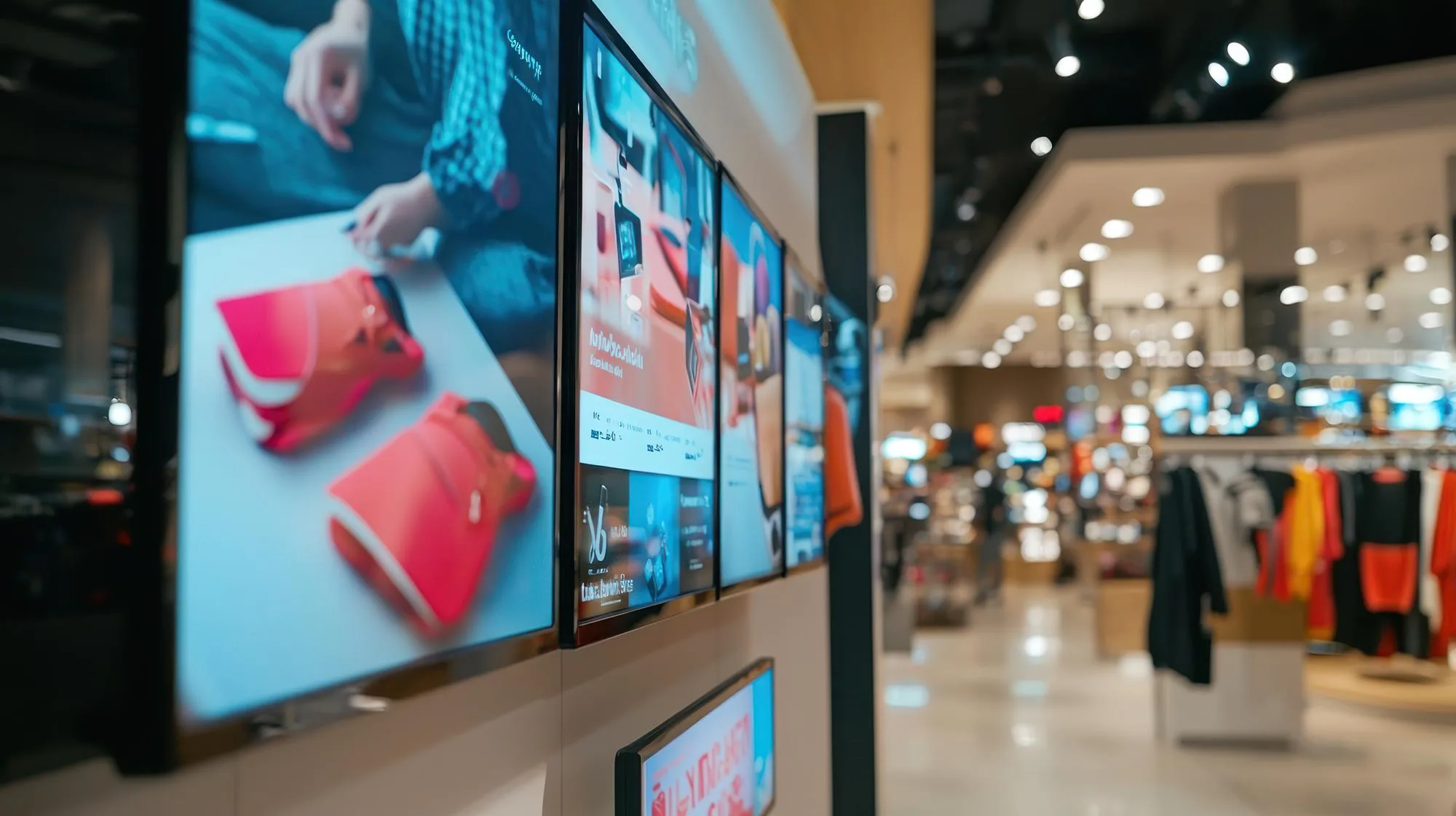
Walk into almost any mall, office lobby, or restaurant in Malaysia today, and there is a good chance a screen is doing some of the talking for the business. What used to be a printed poster or a static menu board has quietly turned into a connected display that updates itself, reacts to the time of day, and reports back on its own performance.
That shift is exactly why digital signage Malaysia adoption has grown so quickly across retail, hospitality, education, and corporate environments. But buying a screen is the easy part. Understanding what actually goes into a working signage system, and what to check before signing with a provider, is where most businesses need guidance.
This guide walks through everything a Malaysian business should know before investing in digital signage, from the hardware and software involved to industry-specific use cases and the questions worth asking before you commit to a provider.
Key Takeaways
- Digital signage involves hardware, software, content, and ongoing support working together
- The right screen size and type depend on viewing distance, location, and purpose
- Cloud-based software is now the standard for managing multiple displays
- Indoor and outdoor environments require different display specifications
- Long-term maintenance and support often matter more than the initial purchase price
What Is Digital Signage?
Digital signage refers to any screen-based display used to show digital content instead of printed material. That covers a wide range of formats, including:
- Menu boards in restaurants and cafés
- Promotional displays in retail stores
- Wayfinding and information screens in malls and transport hubs
- Meeting room and visitor displays in corporate offices
- Video walls for large-scale brand experiences
Unlike a television showing a single channel, a signage display is paired with software that controls what appears, when it appears, and on which screens. That pairing of hardware and software is what makes signage genuinely useful for business communication, rather than just an expensive screen on a wall.
Why Malaysian Businesses Are Investing in Digital Signage
Several factors are pushing adoption higher across both corporate and commercial sectors:
- Instant content updates without reprinting materials
- Consistent branding and messaging across multiple branches
- Stronger customer engagement through dynamic visuals
- Lower long-term costs compared to repeated printing
- Real-time information delivery, from pricing to announcements
For multi-outlet brands in particular, the ability to push one update to every screen nationwide, instead of coordinating printed materials branch by branch, is often the single biggest reason to make the switch.
What a Digital Signage System Actually Involves
Many first-time buyers assume a signage project is just “buy a screen, plug it in.” In practice, a complete system involves several moving parts:
- Display hardware (the screen itself)
- A media player or built-in smart system to run content
- Content management software (CMS) to upload and schedule content
- Network connectivity to push updates remotely
- Installation and mounting
- Ongoing maintenance and support
Skipping any one of these usually shows up later as a problem, whether that is a screen that cannot be updated remotely, a mount that was not built for continuous use, or a provider who disappears after installation.
Choosing the Right Display Size and Type
Screen size is not just a matter of bigger being better. It depends on how far away your audience will be standing, how much space you have, and what the screen is being used for.
- Small standees (32–43 inch) work well for queue areas, standalone promotions, or tight spaces
- Mid-size screens (49–55 inch) suit retail counters, reception areas, and menu boards
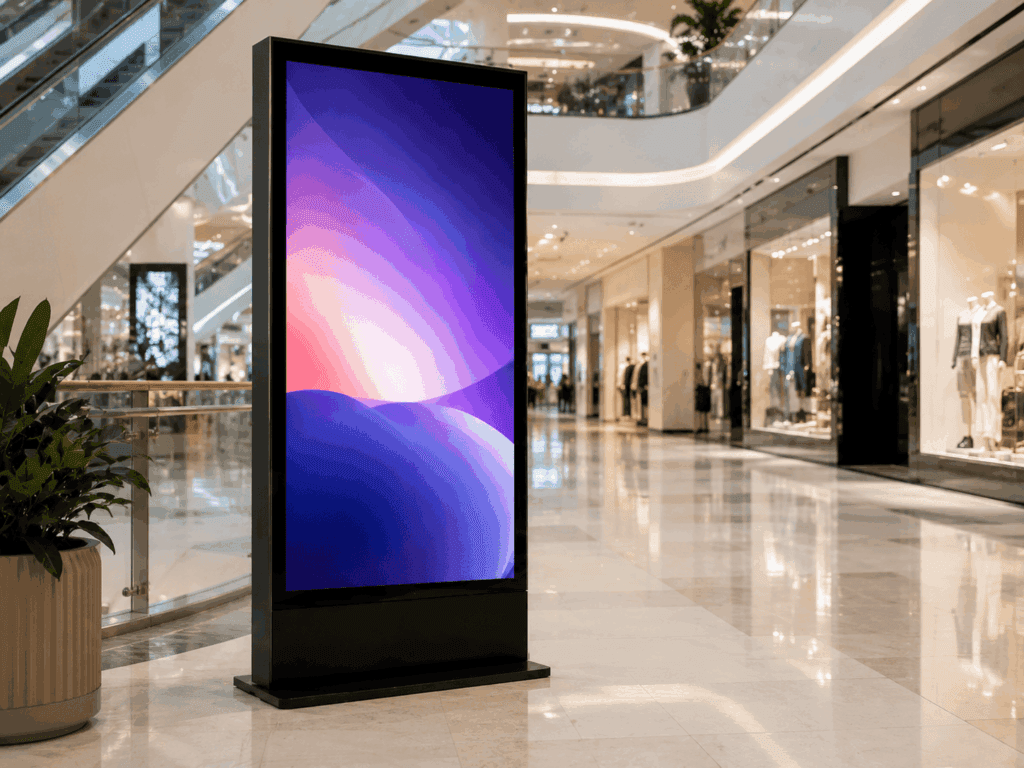
- Large screens and video walls (65 inch and above) suit malls, lobbies, and high-visibility brand spaces
Resolution matters too, but mainly in relation to viewing distance. A screen viewed from two metres away needs far more pixel density than one mounted high above a transportation hub platform.
Indoor vs Outdoor Signage: Different Requirements
Indoor and outdoor environments place very different demands on a display.
- Indoor screens generally use standard commercial-grade panels built for long daily run times
- Outdoor or semi-outdoor screens need higher brightness to remain visible in daylight
- Outdoor installations require weatherproofing and protection against humidity and dust
- LED displays are often used outdoors or in large-format indoor spaces where visibility from a distance matters
Installing an indoor-rated screen in a semi-outdoor area is one of the more common mistakes businesses make, and it usually shortens the hardware’s lifespan considerably.
Why the Software Matters as Much as the Screen
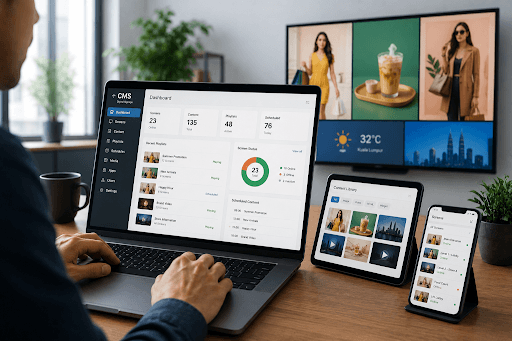
A screen without management software is just an expensive monitor. The content management system is what lets a business actually run a signage network. Most modern platforms are cloud-based, which means content can be uploaded, scheduled, and pushed to multiple screens from a single dashboard, without anyone needing to visit the physical location.
Useful CMS features typically include:
- Remote content uploads and scheduling
- Multi-location and multi-screen management
- Screen status monitoring (online, offline, error states)
- User permission controls for teams
- Offline playback in case of connectivity issues
Digital Signage Use Cases by Industry
Different industries lean on signage for different purposes. The table below summarises how typical use cases and priorities shift depending on the business type.
|
Maintenance and Long-Term Support
Digital displays used commercially often run for ten or more hours a day, every day. That kind of continuous use means maintenance is not optional. Businesses should expect their provider to offer:
- Routine system checks and preventative maintenance
- Fast troubleshooting when a screen goes offline
- Clear escalation procedures for hardware faults
- Replacement planning for ageing hardware
A provider that disappears once the screen is installed leaves the business carrying all the operational risk. This is one of the clearest signs of a basic equipment supplier rather than a true signage partner.
Final Thoughts
Buying digital signage in Malaysia is no longer just a hardware decision. The screen, the software behind it, the installation quality, and the support that follows all determine whether a system actually delivers value over time.
Businesses that take the time to think through display size, environment, software capability, and long-term support before purchasing tend to end up with systems that scale comfortably as the business grows, rather than ones that need to be replaced or reworked within a year or two.
If you are looking for digital signage solutions and still exploring your options, you can go straight to the Blupepper team to talk through your requirements before committing to any setup.