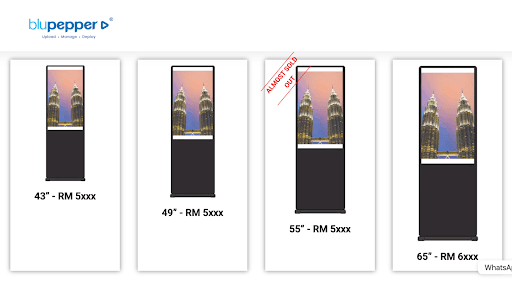
Use this as a starting guide before finalising your display size. Actual requirements may vary depending on content type, brightness, and room layout.
 |
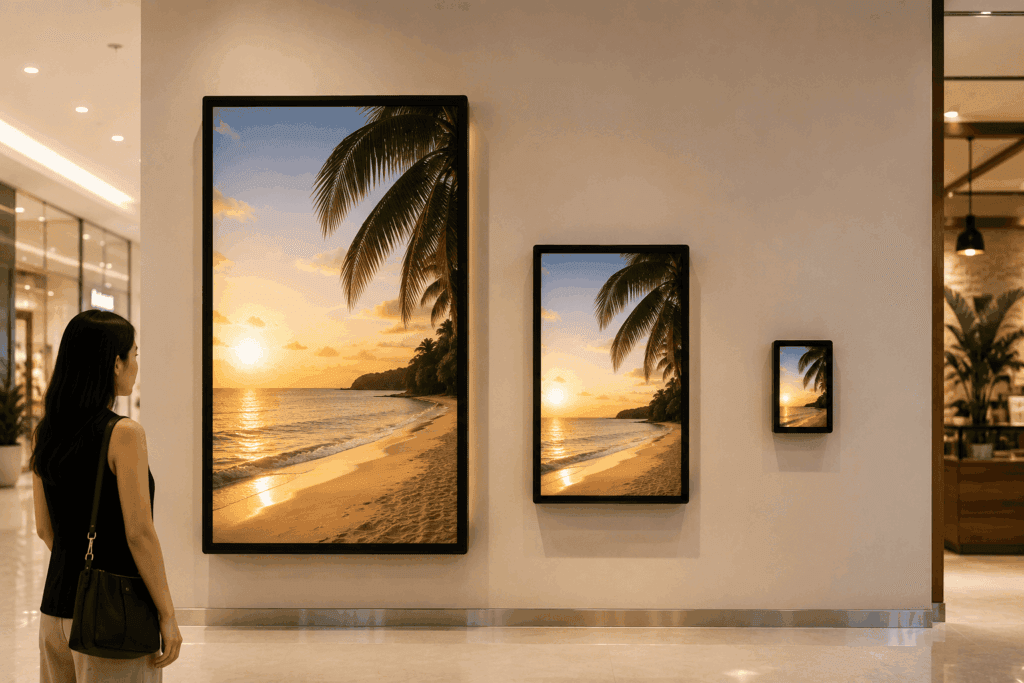
A screen that looks perfect in a showroom can feel completely wrong once it is mounted in your actual space. Too small, and customers walk past without noticing it. Too large, and it overwhelms a tight counter or hallway instead of complementing it.
Size is one of the most underestimated decisions in any digital signage Malaysia project. Businesses often choose based on budget or what looks impressive, rather than what the space and audience actually need. Getting it right means balancing viewing distance, room size, and purpose, not just picking the biggest screen available.
This guide breaks down how to think about digital signage display size, so your screen earns attention instead of being ignored or feeling out of place.
Many businesses approach signage size purely as a cost question: bigger screens cost more, so smaller seems safer. But size also determines whether content is actually legible, whether the display fits naturally into the space, and whether it draws attention without becoming visual clutter.
A screen that is too small in a high-traffic area gets ignored. A screen that is too large in a narrow corridor or small counter can feel oversized and awkward, drawing attention for the wrong reasons.
Before choosing a size, work out how far away people will typically be standing or walking when they look at the screen. This single factor drives almost every other sizing decision.
A screen sized correctly for its viewing distance will always look more proportional and professional than one chosen purely for visual impact.
Use this as a starting guide before finalising your display size. Actual requirements may vary depending on content type, brightness, and room layout.
Matching Size to the Type of SpaceBeyond distance, the type of space itself shapes what size makes sense:
For businesses considering screens for enclosed, climate-controlled spaces such as offices or retail interiors, it is also worth reviewing how indoor digital signage requirements differ from outdoor or large-venue installations, since indoor environments often allow more flexibility in size without sacrificing visibility. Resolution and Brightness Scale Together With SizeA larger screen is not automatically a better screen if the resolution and brightness do not scale with it. As screens get bigger, pixel density and brightness consistency become more important, particularly for large-format displays and video walls viewed from a distance. This is especially relevant for businesses considering LED digital signage, where panel size, resolution, and viewing distance need to be planned together rather than chosen independently. Size Also Affects Content and Software PlanningLarger displays and video walls often require different content formatting, layout zones, and scheduling considerations compared to a single standee. Before finalising hardware size, it is worth checking how your digital signage software handles multi-zone layouts, resolution scaling, and content templates, since the right software can make a large display far easier to manage day to day. Common Sizing Mistakes to Avoid
Final ThoughtsThere is no single correct screen size for every business. The right choice depends on how far your audience stands, how much space you have, and what the display is meant to achieve. A well-sized screen feels natural in its environment and earns attention without effort, while a poorly sized one either disappears into the background or feels out of place. If you are unsure which size fits your space, talk to the Blupepper team to help assess your layout and recommend a size that works for both your budget and your audience. Subscribe To Our Newsletter Get updates and learn from the best More To Explore Free e-book For youWe have an e-book for you. It contains all the pro-tips and step by step guide to help you boost your sales by using digital signage. Request a QuotationDo let us know your requirement so that we can prepare the best solution for you. |